- BIST10011,131-3.02%
- USD50.47+0.05%
- EUR55.46+0.20%
- GOLD3,530.00-4.22%
- INTEREST36.00%-1.00
- BITCOIN58,408-5.65%
- November 20, 202621°
- BIST10011,131-3.02%
- USD50.47+0.05%
- EUR55.46+0.20%
- GOLD3,530.00-4.22%
- INTEREST36.00%-1.00
- BITCOIN58,408-5.65%
- November 20, 202621°
Day after IPO, Anthropic mathematician says Claude helped prove Riemann Hypothesis
Levent Alpöge says he and the company's AI model found a proof of math's most famous open problem. The claim, posted with only computer code, has not been independently verified or peer-reviewed.


A mathematician at Anthropic says he has used the company's AI model Claude to find a proof of the Riemann Hypothesis, a 167-year-old problem widely seen as the most important open question in pure mathematics. The claim, posted Friday, came a day after the San Francisco-based company's record-setting debut on Nasdaq.
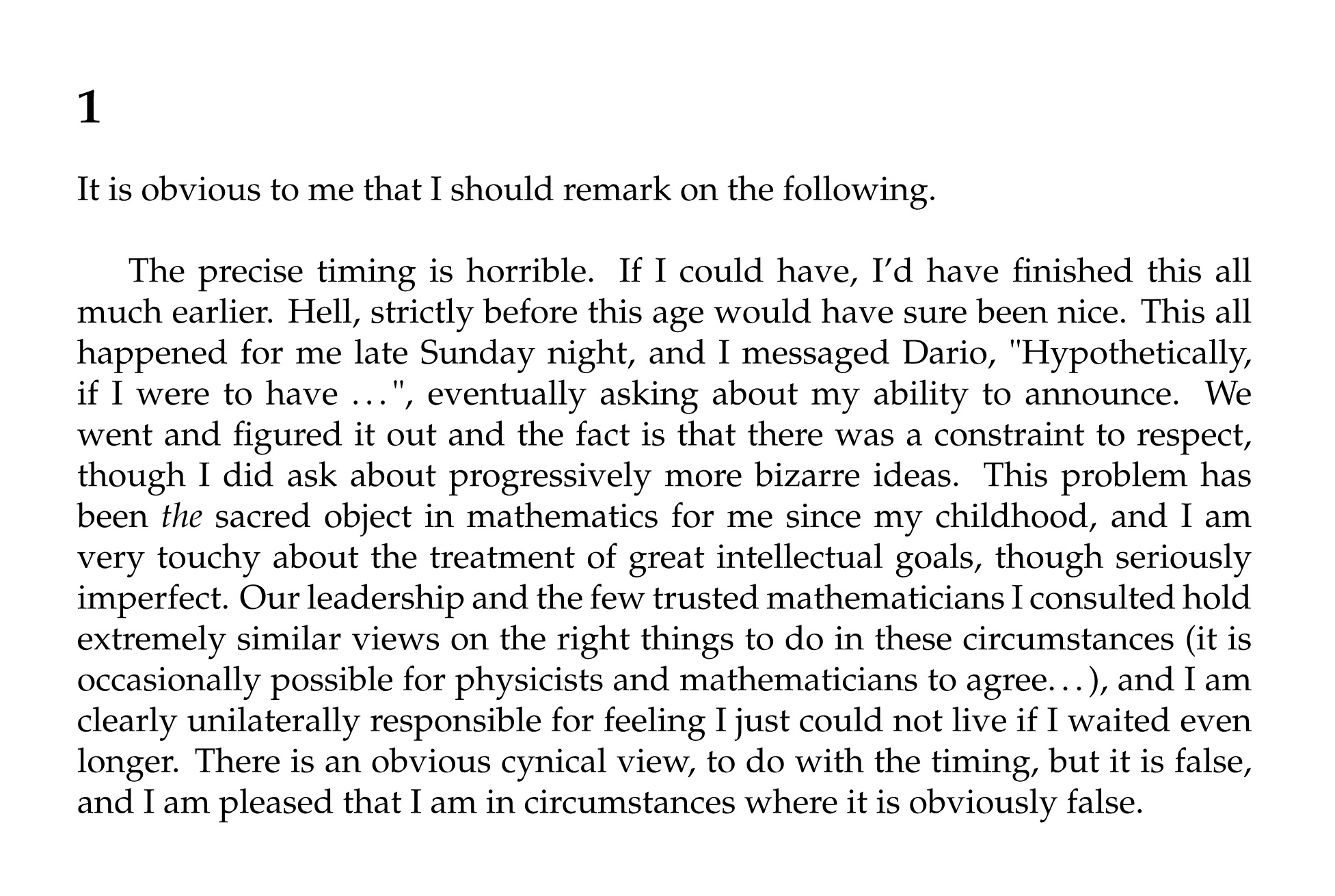
"I believe I have, working with Claude, discovered a proof of the Riemann Hypothesis," Levent Alpöge wrote in a four-page note on his personal website. He said the method also resolves the broader Generalized Riemann Hypothesis.

Timing questions
Alpöge wrote that the work came together late on a Sunday night and that he then messaged "Dario," a reference to Anthropic CEO Dario Amodei, to ask about his ability to announce it. He acknowledged "an obvious cynical view, to do with the timing," but wrote that "it is false." AFP reported that he was probably referring to this week's IPO. According to The Verge, Anthropic has not commented on the announcement.
The claim landed as Anthropic's newly listed shares, trading under the ticker "ANT," fell on their second day amid a broad tech sell-off, NBC News reported.
Proof still unchecked
The proof has not been independently verified or peer-reviewed. Instead of a conventional paper, Alpöge released only a version written in Lean, a programming language that lets a computer check every logical step. MIT mathematician Andrew Sutherland told Scientific American he had compiled the Lean code independently, but said "there is much work to be done to understand the mathematical details of the proof."
Posed by Bernhard Riemann in 1859, the hypothesis holds that all nontrivial zeros of the Riemann zeta function have a real part of 1/2, and it is central to understanding how prime numbers are distributed. It is one of seven Millennium Prize Problems carrying a $1 million award from the Clay Mathematics Institute, which requires a solution to be published and survive two years of scrutiny. In September, rival OpenAI said its AI had solved another one, the Navier-Stokes problem; that result has not yet been formally recognized.
Have a story, event or announcement of your own?Send us your news on WhatsApp
Spotted an error in this story?Report it on WhatsApp
Share on all social platforms
Sponsored Ads
Featured Listings
Loading featured properties...
Stay Updated with Ally Daily
Subscribe to be informed about special news, developments and announcements. We will keep you informed.
By signing up, you agree to our Privacy Policy