- BIST10011,333+2.81%
- USD50.03+0.05%
- EUR56.26+0.56%
- GOLD4,104.80+0.78%
- INTEREST36.00%-1.00
- BITCOIN76,792-4.52%
- November 5, 202621°
- BIST10011,333+2.81%
- USD50.03+0.05%
- EUR56.26+0.56%
- GOLD4,104.80+0.78%
- INTEREST36.00%-1.00
- BITCOIN76,792-4.52%
- November 5, 202621°
Flying to the U.S.? Every passenger must now sign a CDC Ebola form before boarding
Since Nov. 3, everyone boarding an international flight to the United States — including U.S. citizens and green card holders — must sign a CDC attestation confirming they have not been in the Democratic Republic of the Congo in the previous 21 days. Travelers who refuse will be denied boarding, and family members can sign on behalf of relatives who cannot.


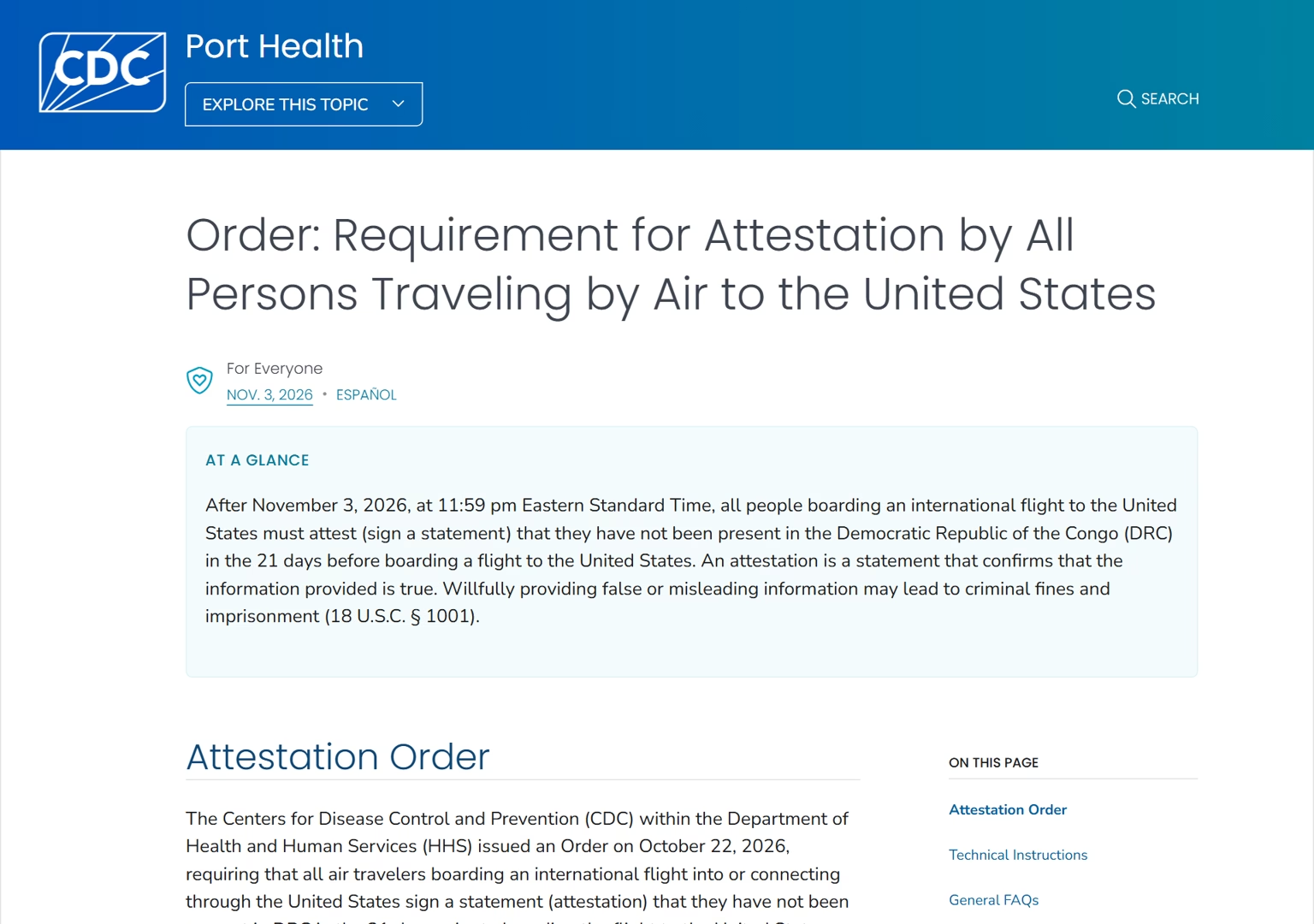
Anyone flying to the United States from abroad now has one more step before boarding: a signed statement to the U.S. Centers for Disease Control and Prevention. Under a CDC order that took effect at 11:59 p.m. Eastern time on Nov. 3, every person boarding an international flight to the U.S. must attest that they have not been present in the Democratic Republic of the Congo (DRC) during the 21 days before the flight. Those who do not sign will not be allowed to board.
The requirement applies to U.S. citizens, U.S. nationals and lawful permanent residents as well as foreign visitors, and it covers passengers who are only connecting through an American airport. CDC first issued the order on Oct. 22 and amended it on Oct. 28 to make clear that crew members on passenger and cargo aircraft must also attest. The agency says the overall risk to the American public and travelers remains low.
Who signs, and who can sign for you
Travelers do not need to print anything in advance. Airlines collect the attestation on behalf of the U.S. government at or shortly before boarding — by a physical or digital signature or an electronic checkbox — and must keep a copy for at least 42 days. CDC has posted a fillable version of the form, known as Attachment A, in English and Spanish for airlines to use, and advises travelers to check with their carrier on how it will be collected.
That matters for families bringing relatives who do not speak English, such as parents or grandparents visiting from overseas. CDC allows an "authorized representative" — a parent, guardian, travel companion or adult member of the same traveling party — to sign on someone else's behalf, and one person may attest for every member of a traveling group, although airlines must keep a record for each individual. Parents or guardians sign for travelers under 18, and a companion can sign for a person who has a disability or is otherwise unable to sign. Airline staff who simply help enter the information do not become the traveler's representative.
What counts as being in Congo
A person is considered to have been in the DRC if they were physically there at any point in the previous 21 days, including entering or traveling through the country by air, land or sea — and even connecting through a Congolese airport without leaving the plane. CDC counts calendar days: the day a traveler leaves the DRC is Day 0, and they may board a U.S.-bound flight starting on Day 22. The 21-day window reflects the maximum incubation period of Ebola.
The rule covers every flight bound for the U.S. — commercial, private, general aviation and cargo — including departures from airports with U.S. preclearance, but it does not apply at land border crossings or seaports. U.S. territories such as Puerto Rico and Guam are not treated as foreign countries. Knowingly giving false information can be prosecuted under federal law, 18 U.S.C. § 1001, which carries fines and possible imprisonment. Narrow exemptions exist for government-authorized medical flights carrying Ebola patients and for individuals CDC exempts on humanitarian or other important government grounds.
An outbreak that keeps spreading
The measure comes as the Ebola outbreak in the DRC continues to grow. World Health Organization Director-General Tedros Adhanom Ghebreyesus said at the agency's weekly briefing on Nov. 4 that more than 10,000 cases and 5,000 deaths had been reported in the country, with nine fatal cases in Kenya and one confirmed case in Nigeria. A vaccine trial began last month, and WHO experts have recommended adding two candidates developed specifically against the Bundibugyo virus.
The attestation is one of several U.S. measures tied to the outbreak. CDC also maintains a separate order suspending the entry of certain people from countries where a quarantinable communicable disease exists, along with guidance for travelers returning from Ebola-affected areas, and the U.S. Department of Transportation has issued an enforcement notice to airlines to back the new rule.
Photo: Wikimedia Commons. Screenshot: U.S. Centers for Disease Control and Prevention
Stay Updated with Ally Daily
Subscribe to be informed about special news, developments and announcements. We will keep you informed.
By signing up, you agree to our Privacy Policy