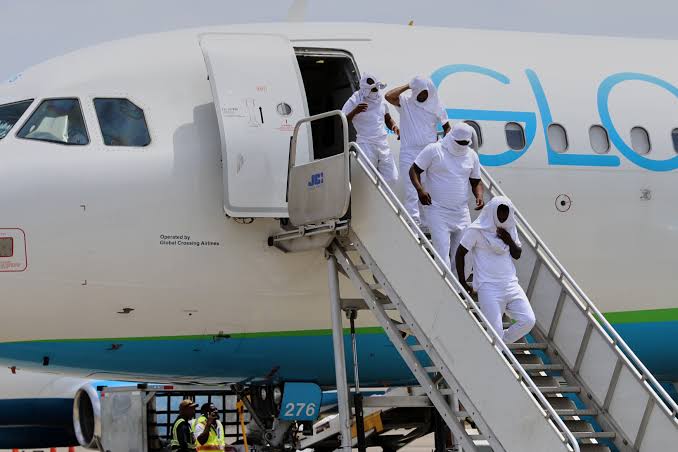
Guyana has received its first group of migrants from the United States under a new migration cooperation arrangement, marking another expansion of Washington's use of third countries in its immigration enforcement strategy.
The first group arrived in the South American country on Friday, September 4, according to Guyanese authorities.
The six individuals include four Cuban nationals and two Afghan nationals. Guyana's Foreign Secretary Robert Persaud said they had been vetted by Guyanese authorities and were found to have no criminal backgrounds.
According to Persaud, the individuals were removed from the United States primarily over immigration-related issues rather than criminal offenses.
The development follows months of negotiations between the governments of Guyana and the United States.
On September 5, the Guyanese government formally confirmed the conclusion of a Migration Cooperation Framework with Washington.
How will the program work?
Under the agreement, Guyana will receive a limited number of vetted, non-criminal individuals from the United States through the International Organization for Migration's Assisted Voluntary Return Programme.
However, Guyana will retain the authority to review and reject any person proposed for relocation.
The Guyanese government has also stressed that it intends to accept only individuals who voluntarily choose relocation to Guyana.
This distinction is important because the agreement does not amount to an unrestricted program under which Washington can automatically send deportees to Guyana.
Each proposed relocation remains subject to Guyanese approval.
The United States will cover relocation costs
The agreement is also designed to prevent Guyana from carrying the financial burden of the program.
According to the Guyanese government, the United States will bear the full cost of the relocation process.
The International Organization for Migration will be responsible for the operational implementation of the program, including receiving, housing and supporting the individuals after their arrival.
Authorities said the arrangement will therefore not require Guyana to cover the costs of accommodating the relocated migrants.
Individuals participating in the program will also be provided with access to communicate privately with their families and legal representatives.

Not permanent resettlement
Guyana has emphasized that the arrangement does not grant the migrants permanent residency in the country.
The six individuals will remain in Guyana while their immigration status is determined.
Depending on the outcome of that process, they could eventually return to their countries of origin or relocate to another country.
People who may require international protection will also retain the ability to seek such protection. Relevant cases can be referred to the United Nations High Commissioner for Refugees in coordination with Guyanese authorities.
Foreign Secretary Persaud said the current arrangement is expected to operate for one year.
He also said the United States had not made any additional requests for Guyana to receive another group as of the latest announcement.
Guyana joins other Caribbean countries
Guyana is not the first country in the region to participate in arrangements involving migrants removed from the United States.
Other Caribbean Community countries, including Belize and St. Kitts and Nevis, have also received small groups under similar arrangements, while St. Lucia was expected to receive its first group.
The agreements form part of a broader U.S. effort to work with third countries when removing certain migrants from American territory.
The policy has become an increasingly significant part of the Trump administration's immigration enforcement strategy.

Why the Guyana agreement matters
Although the first group consists of only six people, the agreement is significant because it demonstrates how Washington's immigration removal strategy is expanding geographically.
Third-country arrangements can provide an alternative when returning an individual directly to his or her country of nationality is difficult or when another country agrees to temporarily receive the person.
At the same time, such policies have generated concerns over migrants' legal rights, access to protection and the conditions they may face after being transferred to countries with which they previously had little or no connection.
Guyana's government says its framework includes safeguards intended to address those concerns.
It has stressed that participation must be voluntary, individuals must be vetted and non-criminal, Guyana retains the right to reject proposed cases, and those who may require international protection will continue to have access to the appropriate procedures.
The arrival of the four Cubans and two Afghans on September 4 represents the first practical implementation of the new Guyana-U.S. framework and adds another country to Washington's growing network of migration cooperation agreements.