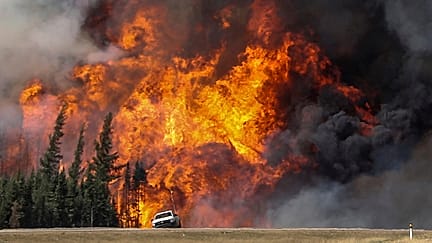
Hundreds of uncontrolled wildfires in Canada have triggered a widespread air pollution crisis across more than 20 US states. NASA data shows over 180 fires active in Ontario alone, and nearly 850 nationwide. Smoke plumes from these fires have prompted air quality alerts across a vast area stretching from the Midwest to the East Coast.
The US Environmental Protection Agency (EPA) states that the greatest threat is fine particulate matter (PM2.5), which is 30 times smaller than a human hair. These microscopic particles can penetrate deep into the lungs and enter the bloodstream.
Dr. Fernando Safdie, a thoracic surgeon and lung cancer specialist in Miami Beach, told Fox News Digital, "The main concern is fine particulate pollution known as PM2.5. These particles are small enough to reach deep into the lungs, and the smallest can pass into the bloodstream." Safdie added that the smoke also carries irritant gases, and this combination triggers symptoms.

What are the health risks for US citizens?
The most common effect of wildfire smoke is respiratory irritation. Dr. Safdie said, "Most people notice a burning or watery sensation, itchy throat, runny nose, or cough." He noted that symptoms can progress to chest tightness, shortness of breath, wheezing, headache, fatigue, and rapid heartbeat.
Safdie warned that smoke can trigger flare-ups or worsen existing symptoms in people with asthma, COPD, or chronic bronchitis, and noted that according to the American Heart Association, wildfire smoke can also strain the cardiovascular system. Smoke is linked to increased emergency room visits for ischemic heart disease, irregular heart rhythm, heart failure, pulmonary embolism, and stroke.
The EPA states that short-term exposure can worsen heart failure and contribute to premature death. Long-term exposure increases the risk of premature death, chronic heart and lung diseases, lung cancer, cognitive decline and dementia, as well as pregnancy complications such as preterm birth and low birth weight.
Who is most at risk in the US?
According to Dr. Safdie, children are at the highest risk because their lungs are still developing and they breathe more air relative to their body size. Older adults, pregnant women, and US citizens with conditions such as asthma, COPD, or heart disease are also particularly vulnerable. Those with weakened immune systems and chronic kidney failure are among other high-risk groups. Outdoor workers are also at risk due to all-day exposure.
How to protect yourself from the smoke
Dr. Safdie noted that outdoor air quality hazards may not always be visible, saying, "Even if you don't see the fires, you can be exposed to smoke and highly polluted air." The Centers for Disease Control and Prevention (CDC) and the EPA recommend the following protective measures for US citizens:
- Monitor air quality: Check air quality at AirNow.gov before going outside. Sensitive groups should limit outdoor activities when the Air Quality Index (AQI) exceeds 100; at 150 and above, everyone should reduce exposure.
- Stay indoors when smoke is heavy: Keep windows and doors closed. If using air conditioning or central HVAC, set the system to recirculate indoor air to reduce the entry of smoky outdoor air.
- Clean indoor air: Run a portable air cleaner with a HEPA filter or use the highest efficiency filter available. Avoid activities that increase indoor air pollution, such as burning candles, smoking, frying food, or vacuuming, when smoke levels are high.
- Wear an N95 mask if necessary: If you must go outside when smoke is heavy, a well-fitting N95 respirator can filter out most harmful fine particles.
- Reduce strenuous outdoor exercise: Intense exercise leads to faster and deeper breathing, increasing the amount of fine particles reaching the lungs. Experts recommend moving workouts indoors until air quality improves.
When to seek help
Dr. Safdie warned, "Don't try to tough it out when breathing becomes really difficult," and said that medical help should be sought for shortness of breath that doesn't improve with rest, persistent cough, wheezing, chest tightness, dizziness, or heart palpitations. He noted that asthma or COPD patients should follow their doctor-prescribed action plan, and said, "If your rescue inhaler isn't working, don't wait. Call 911 for severe shortness of breath, chest pain, or confusion. When in doubt, get checked out."
While short-term exposure is not expected to cause long-term damage, Safdie stressed that "very intense" exposure could lead to chronic problems. He added that those directly in the fire, such as firefighters, must be well protected with proper equipment because the concentration of smoke and PM2.5 would be extremely high and could cause chronic issues. For the general population, he said such exposure is unlikely, and the problem would remain mostly at an acute level.