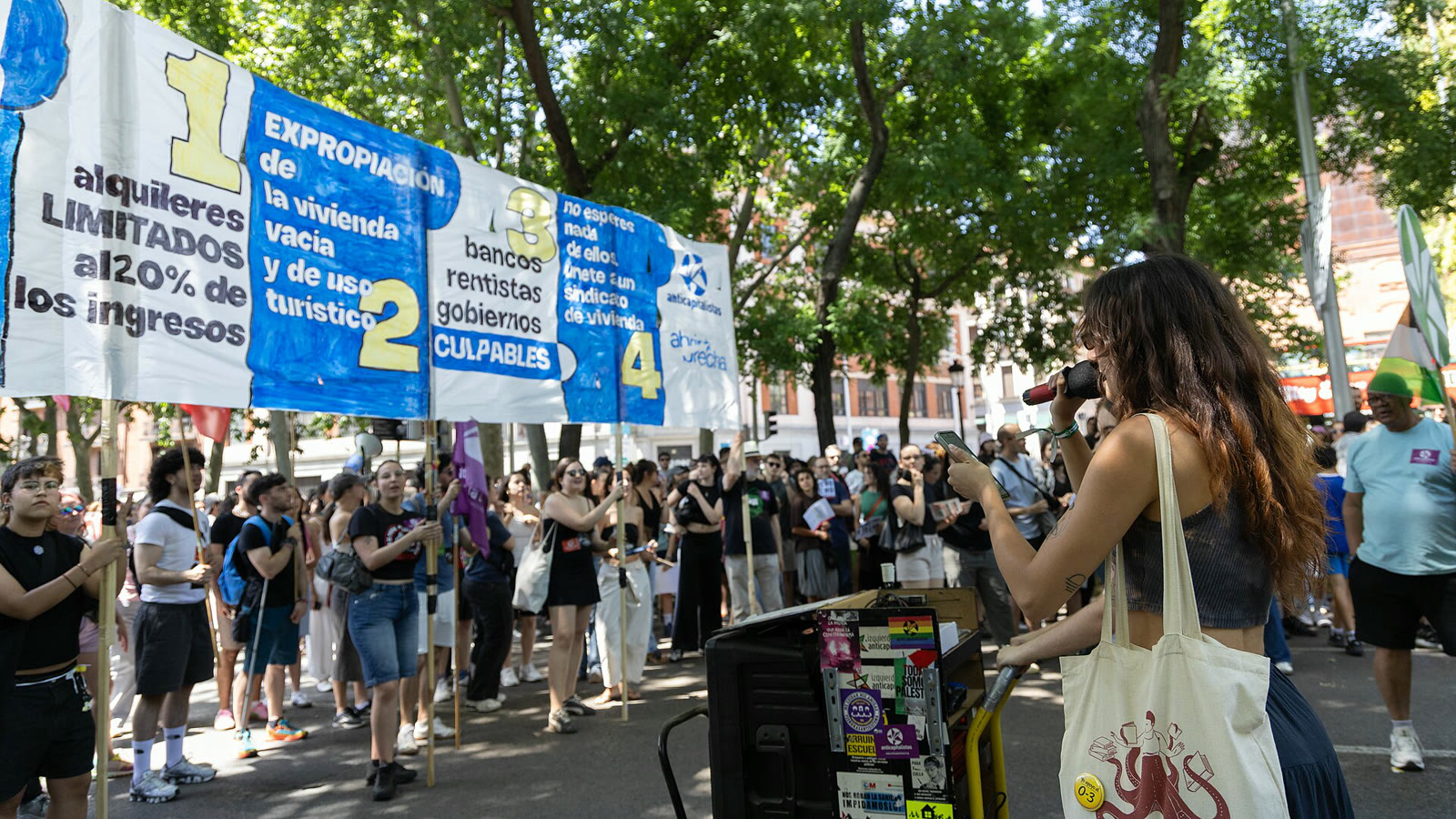
The rejection by parliament of two decrees protecting tenants has intensified nationwide protests against Spain’s housing crisis. The government said around 70,000 people took part in demonstrations in Madrid, while the Madrid Tenants’ Union put the figure at 500,000.
Four separate marches in the capital converged at Cibeles Square. More than 50 demonstrations were held across the country, with protesters calling for a general strike over the housing crisis.
Eviction sparks protests
The protests began after 87-year-old Maricarmen was evicted from her home in Madrid. Following demonstrations outside the home where Maricarmen had lived for 70 years, tents were set up for a week in Puerta del Sol. The protests and protest camps later spread to other cities.
Maricarmen is expected to be able to return to her home following an agreement with the property company.
Parliament rejects two decrees
Following the protests, the coalition government adopted two decrees strengthening tenant protections and limiting evictions. The decrees also included restrictions on investment funds that purchase housing, described as “vulture funds.”
Parliament rejected both decrees on Friday. Protest organizers then began talks with unions to call a general strike as soon as possible.
Gonzalo Álvarez, a spokesperson for the tenants’ union, said their goal was a general strike that would bring the country to a complete standstill over the housing issue and achieve change through organized action.
Protests in Valencia and the Canary Islands
More than 6,000 people took part in a demonstration in Valencia. An estimated total of 5,700 people participated in protests on four Canary Islands.

A march in Barcelona was postponed until Monday evening because of weather warnings. Police used tear gas and plastic bullets after some protesters breached barriers outside a real estate investment forum.
Pressure on Sánchez for an early election
Prime Minister Pedro Sánchez is considering the option of an early election after housing regulations were rejected with the support of the People’s Party, the far-right Vox and the Catalan separatist party Junts.
People’s Party leader Alberto Núñez Feijóo pressured Sánchez to call an election and accused the government of using the housing crisis for electoral purposes. Sánchez has not yet made a final decision on an early election.
Unions agree on 24-hour general strike
The CCOO and UGT trade unions have since agreed to hold a 24-hour general strike in the autumn over the housing crisis, joining the call by the Confederation of Tenants’ Unions. The date will be announced after talks with the confederation and civil society groups, and the strike is expected to take place before the early general election set for Nov. 29.
The unions are seeking wage increases of 4% to 7% and have presented a 10-point plan that includes expanding the stock of permanent public housing, rent controls and full enforcement of the Housing Law in all regions.